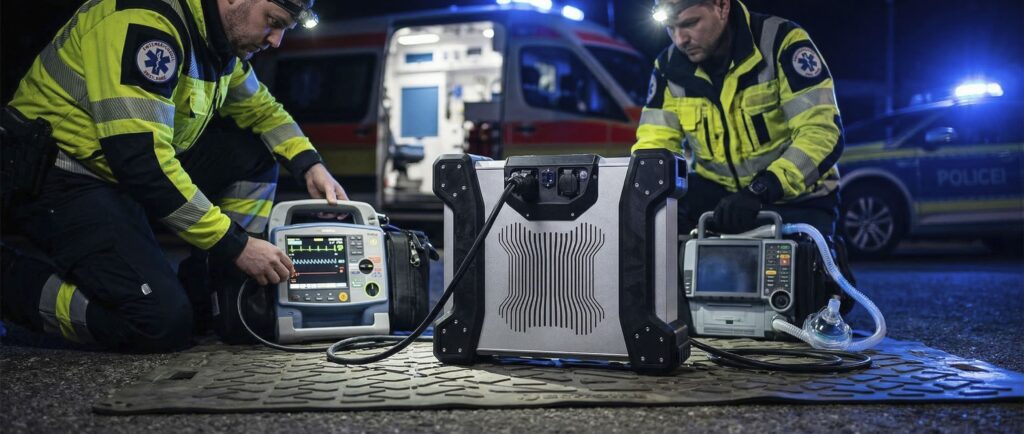
BASECAMP® for emergency services: mission-critical power supply
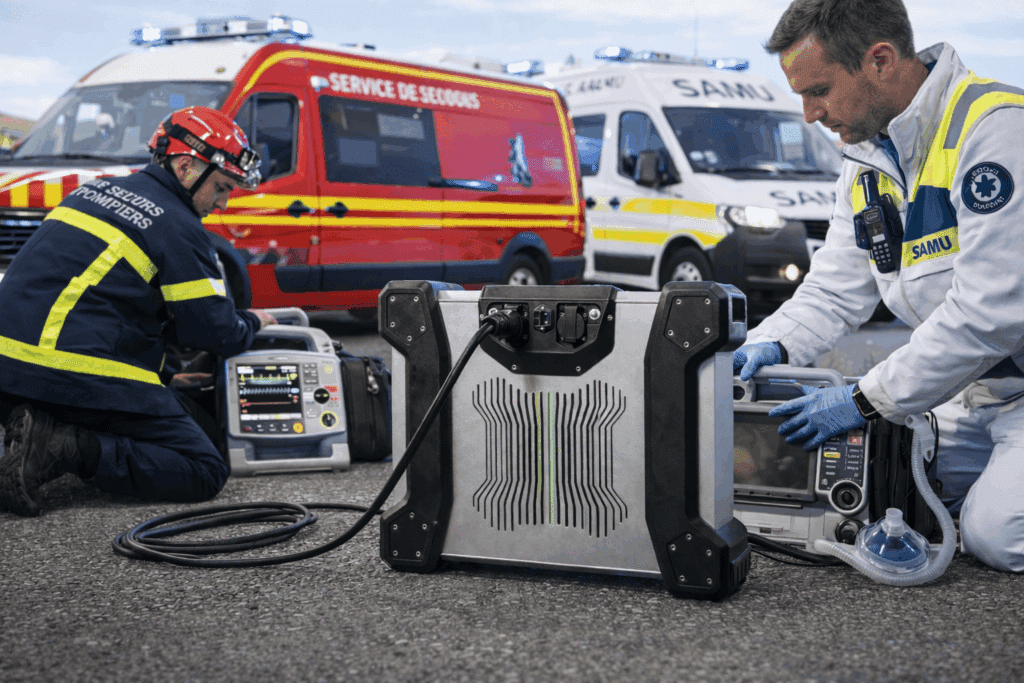
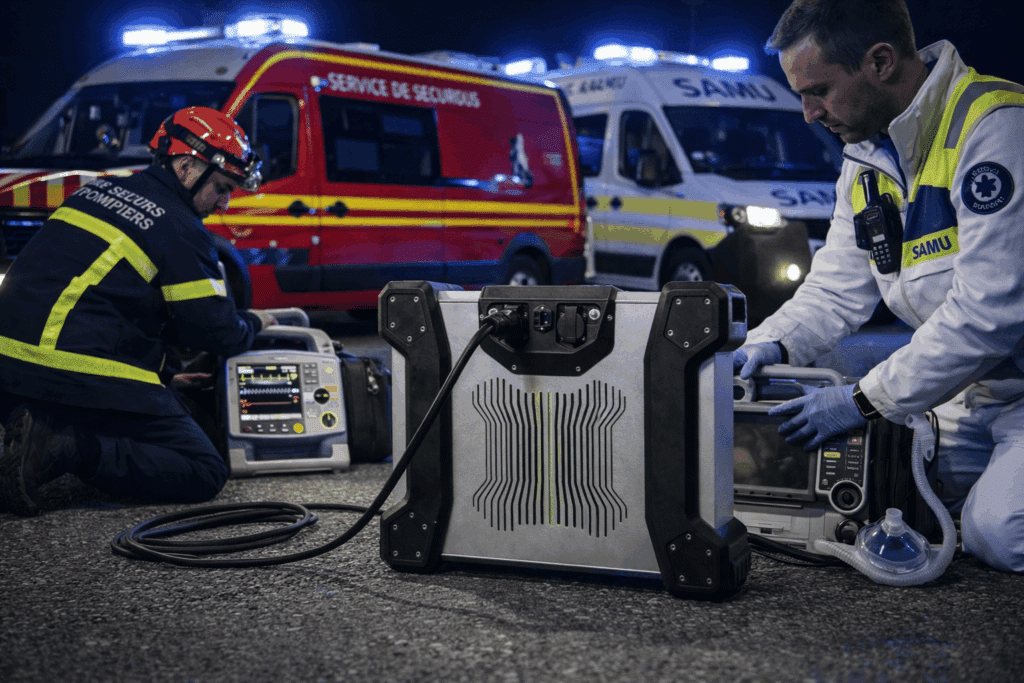
Emergency response units (SAMU-SMUR teams, fire brigades, police emergency units, Red Cross teams, and civil protection services) frequently operate in intervention areas without electrical power or where the grid has been damaged.
The BASECAMP® battery provides an immediately available energy source for critical equipment deployed during medical emergencies, accident response operations, and disaster situations.
Energy requirements for emergency operations
MAXIMUM RESPONSIVENESS
Emergency operations require immediate power deployment, which is incompatible with the startup delays of generators.
CONTINUOUS POWER SUPPLY
Critical medical devices and communication systems cannot tolerate any interruption that could compromise the safety of victims.
DEPLOYMENT IN DEGRADED ENVIRONMENTS
Rough terrain, disaster zones, and adverse weather conditions require exceptional robustness.
ACOUSTIC DISCRETION
Certain operational phases (search for buried victims, radio coordination) require a controlled acoustic environment.
BASECAMP®: the tactical power source for emergency response
The BASECAMP® electric generator provides emergency services with immediate deployment capability combined with operational reliability suited to the constraints of interventions in hostile environments. Its design meets the robustness standards required for professional emergency equipment.
Immediate operational availability
The Plug & Play architecture eliminates preparation phases:
- Instant activation with no mechanical startup sequence
- No initialization phase: power is available as soon as the unit is connected
- Vehicle integration: format optimized for emergency vehicle compartments
- Intuitive operation: deployment possible by any personnel without specific technical training
This immediate availability ensures rapid and efficient deployment during emergency operations.
Energy capacity for emergency equipment
The 7.2 kW continuous power (peaks up to 18 kW) can supply standard emergency response equipment:
- Medical devices (multi-parameter monitors, defibrillators, ventilators, syringe pumps)
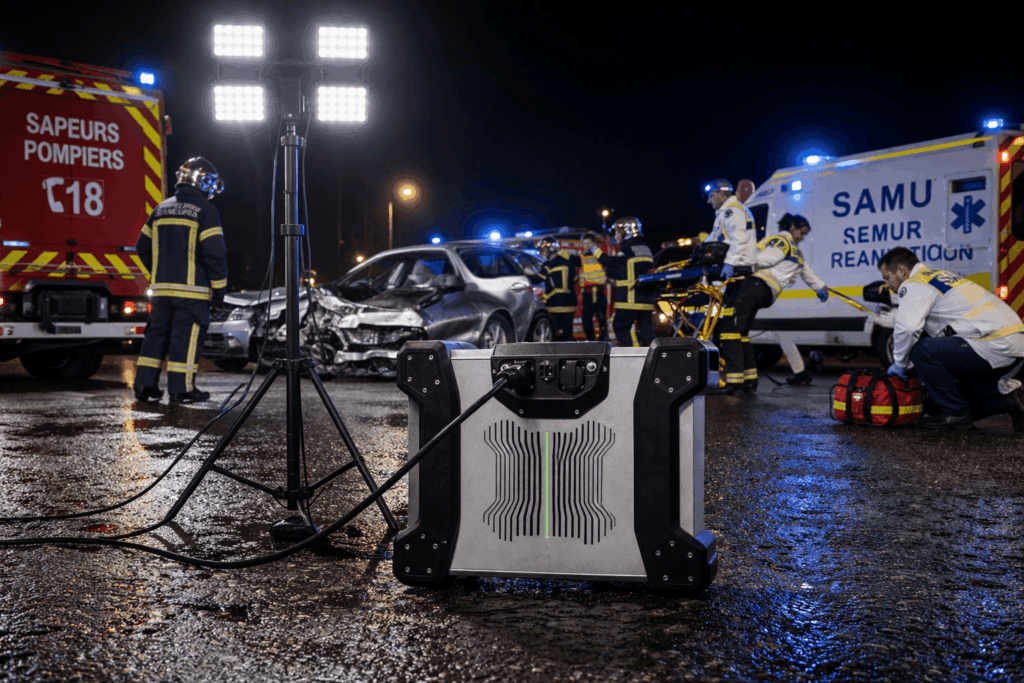
- High-intensity lighting systems for night operations
- Communication equipment (relay systems, computer terminals)
- Motorized rescue equipment (hydraulic spreaders, saws, dewatering pumps)
- Mobile command post installations (computing equipment, monitoring screens, video transmission)
Déploiement flexible entre zones fonctionnelles
Fiabilité technique en conditions opérationnelles
- Surveillance continue avec détection précoce des dysfonctionnements potentiels
- Stabilité de tension protégeant les équipements médicaux sensibles aux variations
- Maintien des performances sur toute la plage de décharge sans dégradation progressive
- Protection IP54 garantissant le fonctionnement sous pluie, projection d’eau et atmosphère poussiéreuse
Do you want to strengthen your energy autonomy?
Logistical optimization for emergency response centers
Integrating BASECAMP® into equipment inventories simplifies operational management, reduces logistical constraints, and improves the availability of intervention resources.
Capacity suited to variable intervention durations
The 3.7 kWh capacity easily covers short interventions (1–2 hours) and allows battery rotation or recharging from vehicle generators for extended operations.A full recharge in 2h30 on a standard 230V mains supply enables a multi-battery strategy for large-scale deployments (natural disasters, preventive emergency posts).
Simplified fuel logistics
BASECAMP® eliminates the need to store gasoline or diesel with their regulatory constraints, removes the need for regular refueling, and avoids risks of spills or contamination. Equipment storage areas can therefore be optimized for other emergency response gear.
Acoustic discretion for specific operations
Silent operation facilitates the detection of faint calls or sound signals during victim search operations and improves operational coordination without radio interference. It also ensures respect for nearby residents during prolonged nighttime urban interventions and provides an optimal environment for responders working under pressure.